
Aquatic Ecology
Our Aquatic Ecology lab spanned the years of 2024 and 2025, with engaging, age-appropriate labs focused on field skills and scientific research on-site in the pristine Laurel Creek Watershed.
The data our students collected contributed to a robust occurrence catalog that provides a meaningful contribution toward the deeper understanding of this regions aquatic ecology, and is accessible via the Global Biodiversity Network, INaturalist, and the scientific publication ARGIA.

"In the end we will conserve only what we love; we will love only what we understand; and we will understand only what we are taught."
Baba Dioum, 1968
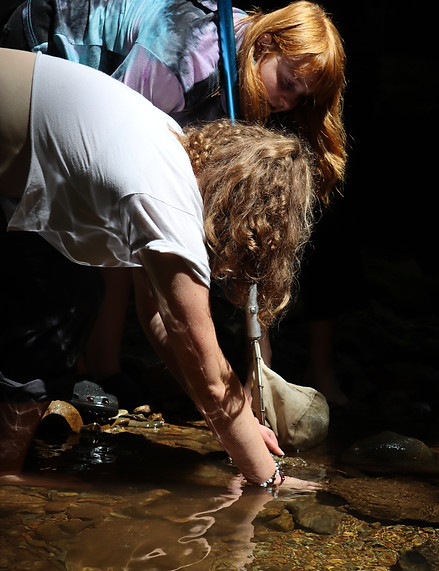
In 2024, high school students were provided with the opportunity to become fully immersed in the daily lessons. This included sifting for and capturing insects in the creek, measuring and logging their specimens, and working alongside career ecologists.
Students learned from experts like Mary Kelly, director of Stream Team, and Dave Penrose, (above) creator of the National Indicator Species Standard.
Beyond hands-on learning, the research the girls logged contributed to the real-world scientific community. For example, our students found and logged two extremely rare species of dragonfly nymphs and helped our community maintain up-to-date data as part of a larger, ongoing watershed assessment.

Joining us for our second year at PAGE in their new and expanded role as a Project Facilitator and STEAM Coordinator, Jaq Reed partnered with Pete Dixon to lead our rising 6th-8th graders in 2025 for our second year of Aquatic Ecology. Students explored the Laurel Creek in search of dragonfly nymphs and were able to capture, identify, and log a wide variety of species. Through a combination of hands-on learning in the waterways at Laurel Creek Community Center and classroom-based lab lessons, students gained impactful knowledge that supplied them with the educational foundation to be citizen scientists.

As a part of our 2025 Aquatic Ecology
lab and in partnership with the
Duke University Marine Lab, we took
our students down to the coast to
explore a different aquatic habitat.
Students were able to tour the Rachel Carson Reserve off the coast of Beaufort and discovered the flora and fauna of a coastal aquatic ecosystem. Once they returned,
they were able to handle marine invertebrates like crabs, urchins, and sea snails.
Back on the mainland, students learned how drones are used for biological research and had the opportunity to pilot drones themselves!


“A river is more than just water...
you just have to look closely”
Sophia, Grade 10

Beyond the capture and catalog of nymphs, students were able to explore the broader concept of a healthy aquatic ecosystem in the region, and discovered a wide array contributing factors that are either to the detriment or benefit of both waterways and their adjoining riparian zones.
The Scientific Method acted as programmatic scaffolding with special emphasis on the importance of research questions, hypotheses/predictions, independent and dependent variables, and methods that helped to prepare the students to plan their own research projects.
Students investigated important and timely research questions, such as “how did Hurricane Helene impact dragonfly nymph populations, if at all?” Their findings will be published later this year in ARGIA.

Students presented their research to the PAGE community and their friends and family during our Exhibition Day. Each group created their own slide presentation that included the full breadth of their small-group research, including their hypotheses, findings, and data in digestible info-graphics.

Our day was jam-packed with learning, and the positive feedback from our students was overwhelming. We are so grateful to have been able to offer such an immersive learning opportunity.
Our thanks to the Duke University Marine Lab, the Burroughs Wellcome Fund, and our tour guides Luke and Hannah for hosting us and creating an unforgettable experience!